Lake Champlain fishing and boating guide
Lake Champlain runs long and narrow between Vermont and New York, with nearly 600 miles of shoreline and enough variety that smallmouth bass, largemouth bass, northern pike and perch all have room to thrive without competing for the same water. Where you fish it depends entirely on which of those four you're after.
One lake, several personalities
At around 280,000 acres, Champlain is genuinely enormous, and its character changes dramatically from one end to the other. Rocky, deeper stretches suit smallmouth bass, while weedy bays and river mouths hold largemouth bass, northern pike and perch. At around 400 feet at its deepest, the lake has real depth to offer, but most fishing happens well above that in the structure-rich shallows and mid-depths.
That range is part of what makes Champlain a serious multi-species destination rather than a lake built around one target fish.
Because the lake runs so long north to south, weather and water temperature can genuinely differ between its ends on the same day, so a pattern that's working in one section isn't guaranteed to hold up if you run a long way to another part of the lake.
Champlain's long history as both a natural lake and a navigable waterway also means it has a wide variety of bottom types, from open sandy flats to rocky shoals to soft, weedy bays, often within sight of each other, which is part of why four different species can thrive here side by side.
Fish species
- Smallmouth bass hold on rock: points, ledges and rocky drop-offs are their core water.
- Largemouth bass favor weedier, calmer water in coves and upper arms.
- Northern pike ambush from weed edges and the backs of coves, and push into wind-blown banks when bait is pinned there.
- Yellow perch school in coves and sheltered bays, often in good numbers once located, and make a dependable target for a more relaxed day on the water.
A pattern worth remembering: wind-blown banks
When wind holds steady from one direction, it pushes baitfish against the downwind shoreline, and predators follow. On Champlain this often means northern pike and smallmouth bass showing up along a bank you wouldn't normally fish, simply because that's where the wind put the food that day.
This pattern is especially useful on a lake this size, because it gives you a quick way to narrow down where to start without needing to already know every piece of structure along nearly 600 miles of shoreline.
Season by season
| Season | Target | Location | Approach |
|---|---|---|---|
| Spring | Pike, perch | Shallow coves and bays as they warm first | Spoon or spinnerbait on the weed edge |
| Early summer | Smallmouth, largemouth | Rocky points and weedy coves | Tube or ned rig on rock; spinnerbait in weeds |
| Summer | Smallmouth | Deeper points and ledges | Tube or ned rig worked slowly |
| Fall | Pike, largemouth | Upper arms, wind-blown banks | Spinnerbait or crankbait along the edge |
| Winter | Perch, pike | Sheltered bays | Small jig or minnow near bottom |
Structure to target
Rocky points that drop quickly into deeper water are smallmouth and largemouth water, typically producing from 8 to 22 feet depending on the day. The backs of coves hold pike and perch in calmer, shallower water where baitfish gather. Where the lake narrows toward an incoming river or creek, moving water concentrates food and draws largemouth and pike in.
Given how much shoreline there is to choose from, picking one or two types of structure to focus on for a trip, rather than trying to sample everything, tends to be more productive than covering a huge amount of water shallowly. A narrower, more deliberate search usually beats a wide, shallow one on a lake this large.
Getting on the water
Lake Champlain has public access on both the Vermont and New York sides, reflecting its size and the long border it shares. Confirm your planned launch is open and appropriate for your boat, and be ready for open-water conditions on the wider stretches of the lake.
Because the lake narrows and widens repeatedly along its length, a ramp near a narrow, protected section can offer a very different day than one that opens straight onto the broad lake, so match your launch choice to the conditions you're comfortable running in.
First-time visitors often do well to pick one section of the lake, rather than Champlain as a whole, and learn it thoroughly before trying to explore further stretches of shoreline on later trips, since the lake rewards familiarity with specific water more than broad coverage.
Safety and rules
- Wear a life jacket; Champlain's open sections can build significant wind and waves with little warning.
- Cold water is a serious risk outside summer, and even summer mornings can start cold on this large a body of water.
- Check both Vermont and New York fishing license and limit rules, since the lake crosses the state line and rules can differ.
- Watch for rock near the surface around points, a common feature of this lake's structure.
- Keep an eye on the forecast through the day, not just before you launch, since conditions on a lake this long can shift from one section to another.
- Give commercial and ferry traffic a wide berth in the narrower crossings, since the lake carries real vessel traffic beyond recreational boats.
Fishing a lake this varied
The upside of Champlain's size and variety is that a slow bite for one species rarely means a slow day overall. If smallmouth aren't cooperating on the rocky points, a short run to a weedy bay can put largemouth, pike or perch in play instead, which makes the lake forgiving for anglers willing to adjust their target rather than sticking to a single plan all day.
Check before you go
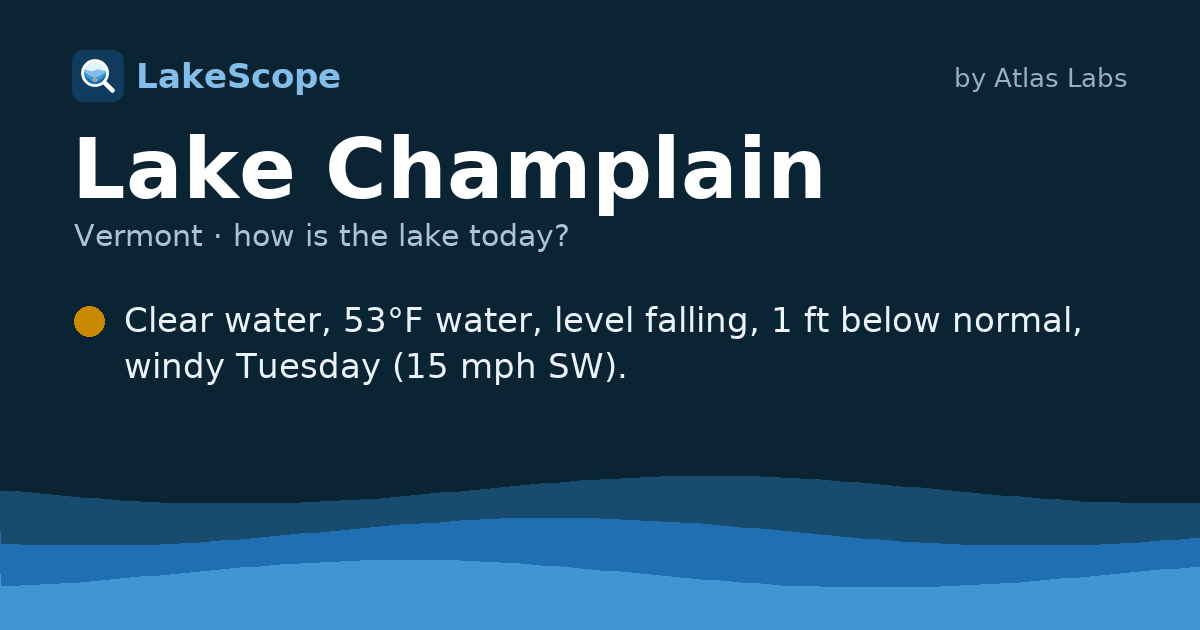
Lake Champlain is big enough that conditions can differ noticeably between its north and south ends. LakeScope shows today's water temperature, level, wind and bite times for the lake so you can plan your trip around the actual day, not an average one.
Questions
How big is Lake Champlain?
About 280,000 acres with nearly 600 miles of shoreline, stretching along the Vermont-New York border.
What fish live in Lake Champlain?
Smallmouth bass, largemouth bass, northern pike and yellow perch are the main species anglers target.
How deep is Lake Champlain?
around 400 feet at its deepest, though most fishing happens in far shallower structure.
Which state do I need a license for on Lake Champlain?
The lake borders both Vermont and New York, so check the rules for whichever state's water you're fishing.
Best spots for northern pike on Lake Champlain?
Weed edges, the backs of coves and wind-blown banks where baitfish get pushed are the most reliable pike water.
Can conditions really differ across Lake Champlain in one day?
Yes, the lake runs long enough north to south that wind, temperature and clarity can vary noticeably between its ends on the same day.
Lake Champlain every morning
Water temperature, level, wind and bite times on your phone.

Lake Champlain today Plan a trip