
Lake Winnipesaukee fishing guide: smallmouth, trout and perch
Lake Winnipesaukee is New Hampshire's largest lake, a deep, island-studded body of water in the heart of the state's Lakes Region. Smallmouth bass and lake trout are the headline fish, with yellow perch and largemouth filling in the shallower coves. This guide walks through where each species holds and how wind changes the plan.
Fish species and where they hold
- Smallmouth bass: rocky points, ledges, and wind-blown banks, especially where the bottom drops fast - they're the most consistent target for anglers casting rather than trolling.
- Lake trout: deep water off points, often trolled near the bottom in summer when surface temperatures push them down into the coolest layer they can find.
- Yellow perch: sheltered coves and bays with a softer bottom, usually schooling tight and easy to catch in numbers once located.
- Largemouth bass: the same quiet coves as perch, usually shallower and tighter to cover like docks, weed edges, and fallen timber.
Structure worth a look
- A wind-blown bank gets extra attention on breezy days - today's wind pushes baitfish against it, and smallmouth and largemouth follow in 4 to 10 feet, often feeding right through the chop.
- Points that drop off quickly hold smallmouth and lake trout stacked along the slope, from the shallows down to around 16 feet, and working the whole slope rather than just the tip usually finds more fish.
- A deeper point drop, extending to roughly 24 feet, is where lake trout sit when they're not actively feeding higher up, which makes it a good fallback spot on slow days.
- Protected coves in the back warm first and hold perch and largemouth in 4 to 10 feet of calmer water, particularly useful on days when wind makes the main lake hard to fish.
Season-by-season plan
| Season | Where | What to try |
|---|---|---|
| Spring | Shallow coves as the water warms | Small jig or minnow near bottom for perch and largemouth |
| Summer | Deep points and open water for trout, rocky banks for smallmouth | Deep trolling near bottom for trout; tube or ned rig on rock for smallmouth |
| Fall | Wind-blown banks and points as baitfish move shallow | Tube or ned rig worked slowly along rock |
| Winter | Deep basins and points through the ice | Jigging spoon or minnow, fished patiently near bottom |
The lake at a glance
Winnipesaukee is the largest lake entirely within New Hampshire, sitting in the Lakes Region near towns like Wolfeboro, Meredith, and Laconia.
It's a deep, cold lake with a lot of shoreline and dozens of islands, which is part of why fish behavior varies so much from one bay to the next - a spot that's firing on one side of an island can be dead calm and quiet on the other.
The sheer number of coves, points, and islands means it rewards exploring a handful of specific spots well rather than trying to cover the entire lake in one trip.
Boat access
Public ramps are scattered around the lake's many towns, so pick one close to the bay or point you intend to fish rather than crossing a lot of open water first.
Open water on Winnipesaukee can get choppy fast once wind builds, so factor ramp location into your safety plan, not just convenience - a ramp on the lee side of the lake gives you a shorter, calmer run home if conditions turn.
Wind and water conditions
Because the lake is large and deep, wind direction matters as much as season. A bank that's been calm all week can turn on the moment wind starts pushing into it, stirring up baitfish and pulling bass and smallmouth tight to the rocks.
Lake trout react less to wind and more to light and temperature, which is why trolling deep stays productive even on calm, bright days when the shallower species have gone quiet.
On a lake with this many islands, wind can funnel and change direction unexpectedly in narrow channels between them, so don't assume the forecast for the whole lake applies exactly where you're fishing.
Safety on the water
- Wear a life jacket - Winnipesaukee is big enough to build real swells when wind funnels down its length, especially in the open, unobstructed middle sections.
- Water stays cold well into early summer; dress for immersion, not air temperature, especially in a smaller boat.
- If fishing through the ice in winter, follow your state and local ice-thickness guidance and never assume ice is safe just because others are on it - thickness can vary a lot across a lake this large, especially near inlets and narrows.
- Check New Hampshire's current fishing license and limit rules before keeping any fish.
Matching gear to the water
A medium-light spinning setup covers most of the smallmouth and largemouth fishing here, light enough to feel subtle bites on a tube or ned rig but with enough backbone to work a fish away from rock.
For lake trout, a trolling setup with line counter or downrigger capability makes it far easier to hold a lure at a consistent depth over a long pass, which matters more on a deep lake like this than it would on something shallower.
Panfish gear for perch can be as simple as a light spinning rod and small jigs - once you find a school, the fishing itself is usually straightforward.
Check before you go
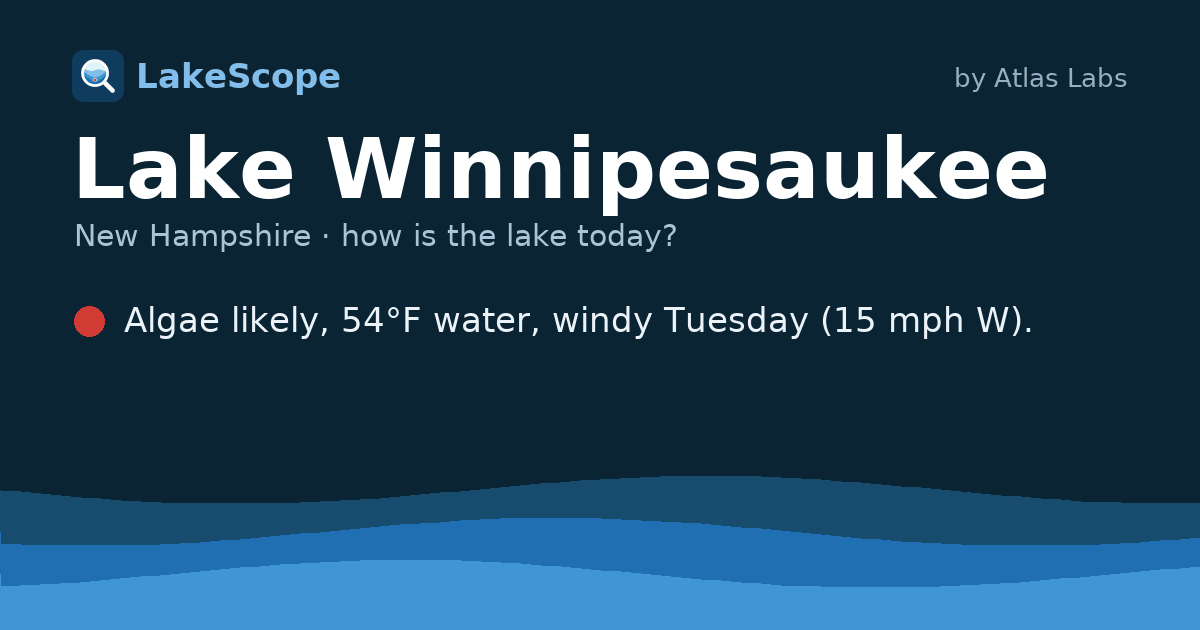
LakeScope shows today's water temperature, level, wind direction, and bite-time windows for Lake Winnipesaukee, so you can see which bank the wind favors before you leave the dock.
On a lake this size, that single check can save a wasted run to a spot that turns out to be sheltered and quiet when the real action is on the other shore.
Questions
How big is Lake Winnipesaukee?
It covers about 44,600 acres with hundreds of miles of shoreline, making it the largest lake entirely within New Hampshire.
How deep does Lake Winnipesaukee get?
More than 150 feet at its deepest, which is part of why it holds a strong lake trout fishery.
What's the best fish to target on Winnipesaukee?
Smallmouth bass are the most consistent target through open water season, with lake trout the draw for anglers willing to fish deep.
Does wind really change where the fish are on Winnipesaukee?
Yes - a bank that the wind is pushing into usually has more active baitfish and more active bass and smallmouth close to it.
Do I need a license to fish Lake Winnipesaukee?
Yes - check New Hampshire's current fishing license and limit rules before you fish.
Are there a lot of islands to navigate around?
Yes - Lake Winnipesaukee has dozens of islands, which creates a lot of sheltered water and points but also means wind and current can behave differently from one channel to the next.
Lake Winnipesaukee every morning
Water temperature, level, wind and bite times on your phone.

Lake Winnipesaukee today Plan a trip