
Lake Fork fishing guide: East Texas trophy bass water
Lake Fork is a reservoir in East Texas built on Lake Fork Creek, and it has one of the best reputations for big largemouth bass anywhere in the country. Crappie, catfish, and bluegill share the water, but bass are why most people come. This guide covers where to fish it through the year.
Why Lake Fork is famous
Lake Fork was built on Lake Fork Creek, a tributary of the Sabine River, and it has long been known as one of Texas's premier trophy largemouth bass lakes.
Standing timber left in place when the lake was flooded gives bass cover throughout the lake, which is a big part of why it fishes so well.
That timber isn't decoration - it's the main reason bass of all sizes have something to relate to almost everywhere on the lake, instead of concentrating onto only a handful of obvious spots the way they might on a more open reservoir.
Species and where they hold
- Largemouth bass: standing timber, points, and the backs of coves, moving between shallow cover and deeper edges with the season.
- Crappie: brush and timber on points and in creek arms, often suspending at a specific depth within the timber rather than sitting on bottom.
- Catfish: coves and deeper water near structure, usually feeding along the bottom rather than up in the timber.
- Bluegill: shallow cover close to the bank, a reliable, easy target for a slower day or a trip with kids.
Structure worth a look
- Points that drop off into deeper water hold bass and crappie along the slope, typically 4 to 20 feet, and working the timber on a point rather than open water nearby usually finds more active fish.
- Backs of coves warm first in spring and concentrate baitfish, bass, and crappie in 4 to 12 feet, often the single best early-season starting point on the lake.
- Upper arms, where a creek narrows into the lake, hold fish in the 12 to 16 foot range when water is moving through, particularly productive after a rain event raises flow.
Season-by-season plan
| Season | Where | What to try |
|---|---|---|
| Spring | Shallow timber and cove backs as bass move up to spawn | Spinnerbait or crankbait around cover |
| Summer | Deeper points and timber, 8 to 20 feet | Slow-worked crankbait or jig near the base of cover |
| Fall | Upper arms and creek points as baitfish move shallow | Spinnerbait or crankbait worked actively |
| Winter | Deeper timber and points near the main lake | Slow jig or minnow fished patiently |
Getting on the water
Access points are spread around the lake's many coves and arms, so it's worth picking a put-in close to the stretch of timber or points you plan to fish.
Because so much of the lake's cover is submerged timber, idle carefully through unfamiliar water rather than running at speed, and keep an eye on your electronics or a visible marker buoy pattern if the lake has one near denser timber fields.
Water level and the timber
Lake Fork's level moves with rainfall and reservoir operations, and the exposed edge of its standing timber shifts with it.
A lower lake exposes stumps and flats that are normally submerged - useful for scouting new structure, but worth running slowly to avoid hitting something you can't see.
A higher lake can put bass up into timber that's usually too shallow to hold water at all, which is worth checking right after a rise before the fish settle back into their usual depths.
Because the lake was flooded over existing creek and field features, even a modest change in level can shift which exact row of timber sits in the fish's preferred depth band, so a pattern that worked at one level may need a small adjustment rather than a complete rethink once the lake moves a foot or two.
Safety and rules
- Wear a life jacket, especially around standing timber where a sudden stop is more likely.
- Idle through timber and shallow coves - submerged stumps are hard to see and can damage a motor or a hull.
- Check Texas's current fishing license and limit rules before you keep anything, since trophy-bass lakes often carry their own size limits.
- Cold water in winter is a real risk even for strong swimmers.
Gear worth bringing
Heavier line and a stouter rod than you might use elsewhere are standard here, since a big bass hooked deep in standing timber needs to be horsed out before it wraps around a limb.
A good pair of polarized sunglasses makes a real difference too - spotting individual trees and stumps just under the surface helps you both fish them accurately and avoid running over them.
A lake that rewards local knowledge
Because Lake Fork's timber fields are so extensive, a sonar unit or simple depth finder that shows individual trees and brush is far more useful here than on a lake with open, featureless bottom.
Spending a trip simply graphing a cove or arm before fishing it - noting where the densest timber sits relative to the nearest drop-off - often pays off more than fishing blind on a new stretch of the lake.
Many regulars fish the same handful of coves and points for years, learning exactly which trees within a given flat hold fish at which time of year - a reminder that on a lake this large and this cover-rich, familiarity with a smaller area can beat randomly covering more water.
Check before you go
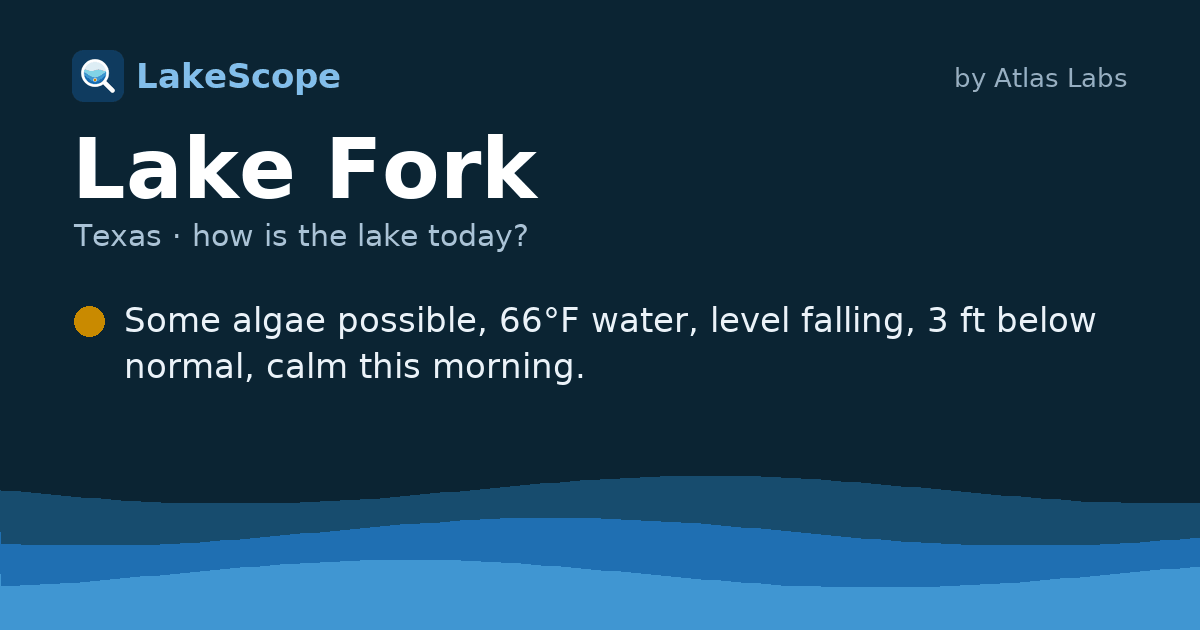
LakeScope shows today's water temperature, level, wind, and bite-time windows for Lake Fork, so you can see how the lake is sitting before you commit to a stretch of timber.
On a lake known for subtle depth changes mattering a lot, that quick look can be the difference between fishing water that's two feet too shallow and finding the right band of timber for the day.
Questions
Why is Lake Fork known for big bass?
It's long been one of Texas's top trophy largemouth bass fisheries, helped by abundant standing timber that gives bass cover throughout the lake.
How big is Lake Fork?
It covers about 27,000 acres with more than 300 miles of shoreline.
What's the best bait for Lake Fork's timber?
A spinnerbait or crankbait worked around timber and points covers water well; slow it down near the base of cover when fish aren't chasing.
Is Lake Fork good for crappie too?
Yes - crappie hold in the same brush and timber as the bass, especially around points and creek arms.
Do I need a license to fish Lake Fork?
Yes - check Texas's current fishing license and limit rules, since trophy lakes like Lake Fork sometimes carry their own size limits.
Is it hard to navigate Lake Fork because of the timber?
It takes some caution - idle through unfamiliar timber and shallow coves rather than running at speed, since submerged stumps can be hard to see.
Lake Fork every morning
Water temperature, level, wind and bite times on your phone.