
Lake Oroville fishing guide: trout and spotted bass
Lake Oroville is a deep Northern California reservoir behind one of the country's tallest dams, and its water level can swing a long way between wet and dry years. Trout and spotted bass are the main targets, both usually holding deep. This guide covers where to find them and how big a difference the lake's level makes.
The lake at a glance
Lake Oroville sits on the Feather River behind Oroville Dam, near the city of Oroville in Northern California, and is part of the State Water Project.
It's one of the deepest reservoirs in this guide, reaching around 690 feet at its deepest point, with about 167 miles of shoreline when full.
Because the lake occupies a steep canyon system rather than a flat basin, its shoreline is made up mostly of bluffs, points, and arms rather than gradually sloping flats - which is part of why so much of the fishing here happens on structure that falls away quickly rather than spreads out shallow.
Fish species and depth
- Spotted bass: rocky points and ledges, usually in 10 to 24 feet of water, and more tolerant of the clear, deep conditions here than largemouth tend to be.
- Trout: open water over points and drop-offs, often caught trolling rather than casting, since they roam more than they hold tight to a single piece of structure.
- Catfish: quieter, softer-bottomed stretches away from the main current, feeding mostly after dark or in low light.
Structure worth a look
- Points that fall away quickly into deep water hold trout and spotted bass stacked along the slope, typically 10 to 24 feet down, and trolling or casting along the full length of the point usually out-produces fishing just the tip.
- A steep ledge beside deep water is a good bet when fish are holding tighter, usually 10 to 16 feet, especially on bright days when fish pull off the open slopes.
- Upper arms where the lake narrows toward incoming creeks concentrate baitfish and trout, especially around 10 to 24 feet, and are worth checking first after any rain pushes new flow into the lake.
- Backs of coves hold trout when the surface is cooler, generally 10 to 24 feet down, particularly in the shoulder seasons before the whole lake warms or cools uniformly.
Why water level matters here
Oroville is a working reservoir, and its level can change a great deal across a season or between a wet year and a dry one, more dramatically than on many of the other lakes in this guide.
A big drop exposes ramps, flats, and old shoreline structure that was underwater before, and pushes fish off their usual cover onto the nearest deep edge. Scouting the shoreline at low water is one of the best ways to find new structure for when the level comes back up.
Always check the current level before you launch, since a boat ramp that worked last trip may be high and dry now, and a point that held fish at one level might be too shallow or too deep to matter at another.
Technique that works
Because most of the productive water here is well below the surface, trolling spinners or spoons slowly along points and ledges accounts for most of the trout and spotted bass caught.
Fish a little slower and a little deeper than you would on a shallower lake - Oroville's clear, deep water rewards patience over covering a lot of water fast.
Clear water also means fish can see line and lures well, so lighter line and natural presentations tend to out-fish anything flashy or oversized, especially for spotted bass holding tight to rock.
Boat access
Ramp availability changes with the lake's level, and in low years some ramps close while others extend farther out to reach the water.
Always confirm a ramp is open and usable at the current level before towing a boat any distance to it - a wasted trip to a closed ramp costs real time on a lake this large.
Safety and rules
- Wear a life jacket - open water on a deep reservoir can get rough quickly once wind picks up, particularly in the more open main body of the lake.
- Cold water is a real risk even on a warm day, since deep reservoirs like Oroville stay cold well below the surface no matter how hot the air is.
- Watch for newly exposed stumps, rock, and other hazards when the lake is low - they can be invisible just under the surface and are a common source of prop and hull damage.
- Check California's current fishing license and limit rules before you fish.
A lake worth exploring by arm
Oroville splits into several distinct arms where different creeks feed in, and each one can fish a little differently depending on how much flow it's carrying and how exposed it is to wind.
Rather than trying to cover the whole lake in a day, picking one arm and fishing several of its points and ledges thoroughly tends to produce better results than running all over looking for fish.
Because the canyon walls funnel wind in sometimes unpredictable ways, conditions in one arm can look completely different from the main body of the lake just a short run away - checking a sheltered arm is often the better call once wind picks up on the open water.
Check before you go
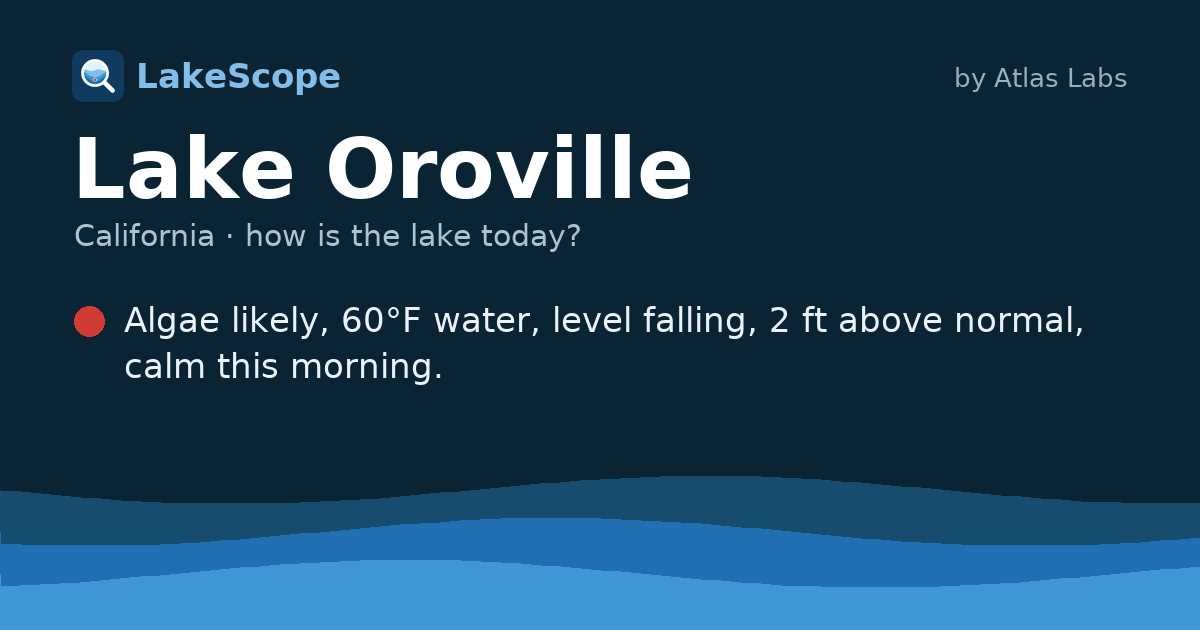
LakeScope shows today's water level, temperature, wind, and bite-time windows for Lake Oroville, so you know exactly how low the lake is and where the fish are likely holding before you head out.
Given how much this lake's level can move between visits, that check is worth doing every time rather than assuming conditions match your last trip.
Questions
How deep is Lake Oroville?
It reaches around 690 feet at its deepest, making it one of the deeper reservoirs in Northern California.
Why does Lake Oroville's water level change so much?
It's a working reservoir on the Feather River, managed for water supply and flood control, so its level rises and falls with rainfall, snowmelt, and releases through the year.
What fish can I catch at Lake Oroville?
Spotted bass, trout, and catfish are the main species, with most fish holding on deep points, ledges, and drop-offs.
Is it safe to fish Lake Oroville when the water is low?
Low water exposes ramps and underwater hazards like stumps and rock, so go slowly, watch for obstructions, and confirm your ramp is still usable before you launch.
Do I need a fishing license for Lake Oroville?
Yes - check California's current fishing license and limit rules before you fish.
Is trolling better than casting on Lake Oroville?
Trolling tends to cover more of the deep, open water that trout roam, while casting around points and ledges works well for spotted bass holding tighter to structure.
Lake Oroville every morning
Water temperature, level, wind and bite times on your phone.

Lake Oroville today Plan a trip