
Table Rock Lake fishing guide: spots and seasons
Table Rock Lake winds through the Ozarks with more than 700 miles of shoreline packed into a relatively compact footprint, which means points, coves and creek arms are never far apart. Largemouth bass, crappie, white bass and walleye all share this water, and most of them key on the same structure: rocky points and the backs of coves.
The lake at a glance
At roughly 43,000 acres and around 220 feet at its deepest, Table Rock is a mid-size reservoir on the White River with a shoreline that folds back on itself constantly. That shoreline-to-surface-area ratio is high, which is why Ozark lakes like this one feel like a network of small bays rather than one open body of water.
The lake sits downstream of its sister reservoirs in the White River chain, and its clear, rocky-bottomed water rewards anglers who fish structure precisely rather than blind-casting open water.
That clarity also means fish can be a little more cautious around bright, calm conditions than they would be in a murkier lake, which is part of why low-light hours and slightly stained water after rain often fish especially well here.
The lake also supports a healthy forage base of shad and other baitfish throughout its arms, which keeps predator species well distributed rather than concentrated in just a few well-known hotspots.
Fish species and where to find them
- Largemouth bass are the most commonly targeted fish, holding on points, ledges and in coves depending on the season.
- White bass school and feed aggressively, often near points where current or wind concentrates baitfish.
- Crappie favor brush and the calmer backs of coves, especially in spring and early summer.
- Walleye tend to sit deeper and feed low, often overlooked by anglers focused on bass but a dependable target once you adjust depth and speed for them.
- All four species share the lake's rocky, clear-water structure to some degree, so a single trip focused mainly on points and ledges can realistically put more than one of them in the boat.
Season-by-season plan
| Season | Target | Location | Bait/approach |
|---|---|---|---|
| Spring | Largemouth, crappie | Shallow coves and creek arms as water warms | Spinnerbait or crankbait along the edge |
| Early summer | White bass, largemouth | Points and upper arms | Spinnerbait or crankbait, faster retrieve |
| Summer | Crappie, walleye | Deeper points and ledges | Slower presentation near bottom |
| Fall | Largemouth, white bass | Backs of coves, wind-blown banks | Match the bait size moving into coves |
| Winter | Crappie, walleye | Deepest available structure | Slow and patient, near bottom |
Structure and spots worth a look
Points that fall away quickly into deep water hold largemouth and white bass at 4 to 16 feet along the slope. The backs of coves give a sheltered, shallower option where baitfish gather and crappie and largemouth both show up. Where a cove narrows into its feeding creek arm, moving water concentrates food and fish follow it in.
Because so many of these features repeat around the lake's long, winding shoreline, a pattern that works on one point in a cove often works on a similar-looking point a mile away, which makes Table Rock a good lake for building confidence in a repeatable approach rather than treating every spot as a one-off puzzle.
Boat ramps and access
Table Rock has numerous public and resort-run access points scattered along its arms, which is typical for a reservoir this shape. Confirm the specific ramp you plan to use is open and matches your boat size before heading out, since access can vary by season and water level.
Because the lake's arms can be a considerable drive apart by road even when they're close by water, picking a ramp near the section you intend to fish saves meaningful time compared to launching at the nearest convenient spot and running a long way across the lake.
Many of the resort-run ramps also offer fuel, bait and basic supplies, which can be a useful backup if you're running low on something mid-trip rather than heading all the way back to your original launch point.
Water level and what it changes
Table Rock's level moves with rainfall and reservoir management upstream and downstream, and even modest changes can expose or submerge the brush and rock that fish relate to on points and in coves. A rising lake often pushes fish shallower and into newly flooded cover, while a falling lake concentrates them on the remaining deeper structure.
After a significant rain event, incoming creek arms can run noticeably more turbid than the main lake for a few days, and fish often push into that stained water to feed, which is worth factoring into where you start a trip right after a storm.
Safety and rules
- Wear a life jacket, especially on busier summer weekends when boat traffic is heavy.
- Watch for sudden wind across open stretches of the lake, which can build chop quickly.
- Cold water in winter and early spring is a real risk even when the air feels mild.
- Check Missouri's fishing license and limit rules for Table Rock before you go.
- Give extra room to swimmers and personal watercraft near resort areas and marinas, which see heavy recreational use in warm months.
- Run at reduced speed near coves and narrow arms where visibility around bends is limited and other boats may be approaching from the opposite direction.
Fishing around the pressure of a popular lake
Table Rock sits close enough to Branson that it sees heavy recreational boat traffic in the warmer months, which can push fish on the most obvious, easy-to-reach points into a more cautious mood by midday. Fishing earlier in the morning, or working slightly less obvious secondary points and the backs of quieter coves, often produces better results than competing for the same handful of well-known spots everyone else is already fishing.
Check before you go
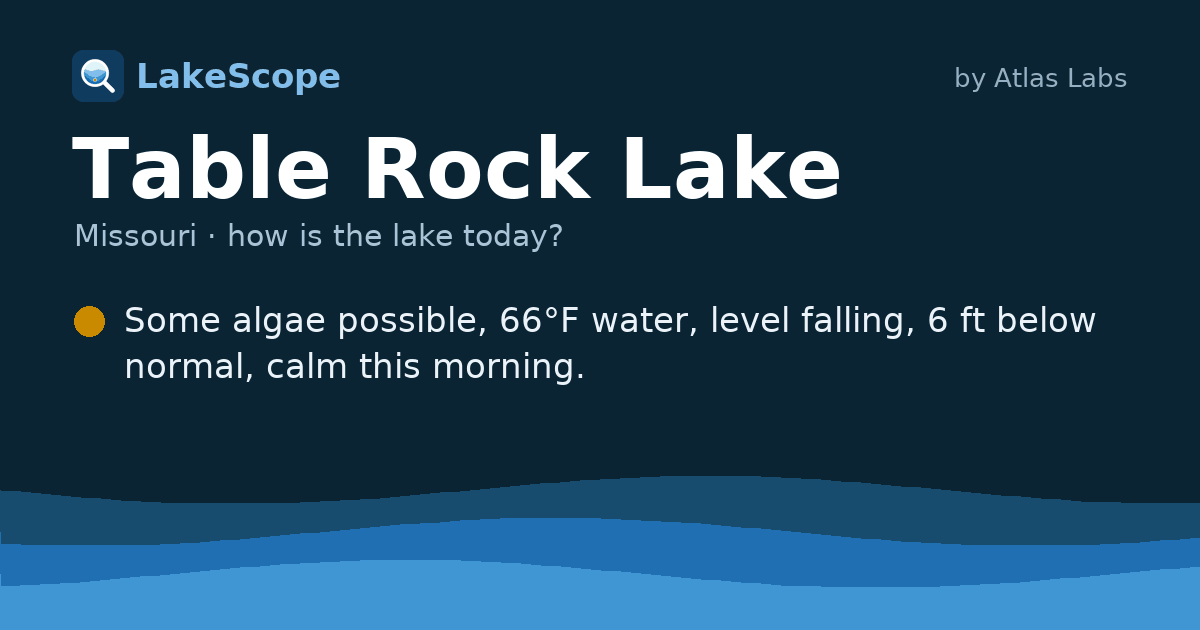
LakeScope shows today's water temperature, level, wind and bite times for Table Rock Lake, so you can match your plan to current conditions instead of guessing from a seasonal average.
Questions
How big is Table Rock Lake?
About 43,000 acres with more than 700 miles of shoreline, and roughly 220 feet at its deepest.
What fish can I catch at Table Rock Lake?
Largemouth bass, crappie, white bass and walleye are the main species, with largemouth and crappie the most commonly targeted.
Where is Table Rock Lake?
It's in southwest Missouri, part of the White River chain of Ozark reservoirs.
Best spots for crappie at Table Rock Lake?
Look for brush and the backs of sheltered coves, which hold baitfish and the crappie that follow them.
Does the water level at Table Rock change much?
Yes, it moves with rainfall and upstream/downstream reservoir management, which can expose or flood the cover fish use on points and in coves.
Does rain change where fish feed at Table Rock?
Yes, creek arms often run more turbid for a few days after heavy rain, and fish will frequently push into that stained water to feed.
Table Rock Lake every morning
Water temperature, level, wind and bite times on your phone.

Table Rock Lake today Plan a trip