
Lake Tahoe fishing and boating guide
Lake Tahoe is one of the clearest, coldest large lakes in the country, and both of those traits shape everything you do on it. Mackinaw (lake trout) and kokanee live deep most of the year, visibility runs far below the surface, and the water stays cold enough to be dangerous even in summer.
Why Tahoe fishes differently
At around 1,645 feet at its deepest, Tahoe is one of the deepest lakes in the country, and that depth plus exceptional clarity means sunlight reaches far down into the water. Baitfish and the lake trout that chase them don't need to stay shallow to find comfortable, well-lit water, so the fish you're after are often suspended 100, 300, even 700 feet down rather than hugging the bank.
That clarity is also why Tahoe looks so blue from shore. It comes from very little algae and sediment in the water, which is good for sightseeing but means the lake doesn't warm quickly and doesn't hold the dense weed beds that largemouth bass rely on elsewhere. Fish here orient to structure and temperature breaks more than to vegetation.
The lake's sheer volume also means it resists temperature swings that smaller lakes go through in a single week. A hot spell that pushes a shallow reservoir's surface temperature up several degrees barely registers on Tahoe, which is part of why the deep, cold-water fishery here stays consistent across most of the year rather than shifting dramatically month to month.
What's swimming in it
- Mackinaw (lake trout) are the headline fish, often caught by deep trolling near the bottom or along steep drop-offs, and they're the species most associated with Tahoe specifically.
- Trout, including rainbow and other stocked trout, are more likely near the surface in spring and fall when the water column is cooler throughout.
- Kokanee, a landlocked salmon, school at mid-depths and are a popular summer troll target, often providing more consistent action than mackinaw on a given day.
- Smallmouth bass hold around rocky points and ledges, mostly in the shallower, warmer coves where the water has a chance to warm up.
Season by season
| Season | What's biting | Where to look | Approach |
|---|---|---|---|
| Spring | Trout, smallmouth | Shallower coves and points as water warms | Shallower trolling or casting near rock |
| Early summer | Mackinaw, kokanee | Suspended over deep water, upper arms near inflows | Deep trolling near bottom, spoon or spinner |
| Late summer | Mackinaw, kokanee | Deeper still as surface warms | Troll a spoon on deep edges and ledges |
| Fall | Trout, smallmouth | Points and ledges as baitfish move shallower | Troll slowly or cast rocky structure |
| Winter | Mackinaw | Deep basins and steep drop-offs | Deep trolling near bottom, go slow |
Structure worth trying
Points that drop fast into deep water are reliable for mackinaw and trout holding at 10 to 24 feet near the slope, or deeper on the steep ledges where the bottom falls away sharply. Coves give a sheltered, slightly shallower option when wind is up. Where the lake narrows toward an inflow, baitfish concentrate and trout and mackinaw follow, sometimes staying very deep even there.
Because so much of Tahoe's productive water sits well below what you can see, a sonar unit or a reliable depth reading matters more here than on a shallow weedy lake where you can often spot fish or structure visually. Knowing the contour of a point or ledge before you arrive saves a lot of blind trolling time.
Boating and access
Tahoe sits across California and Nevada with marinas and public launches scattered around all sides of the lake. Afternoon winds build quickly out of calm mornings, and the open width of the lake gives waves plenty of room to grow, so check the forecast before committing to a long crossing.
The lake's size also means conditions can differ noticeably from one shoreline to another on the same day. A sheltered bay can be glassy calm while the open middle of the lake is kicking up real chop, so don't assume conditions near your launch point will hold for the whole trip.
Water level and clarity
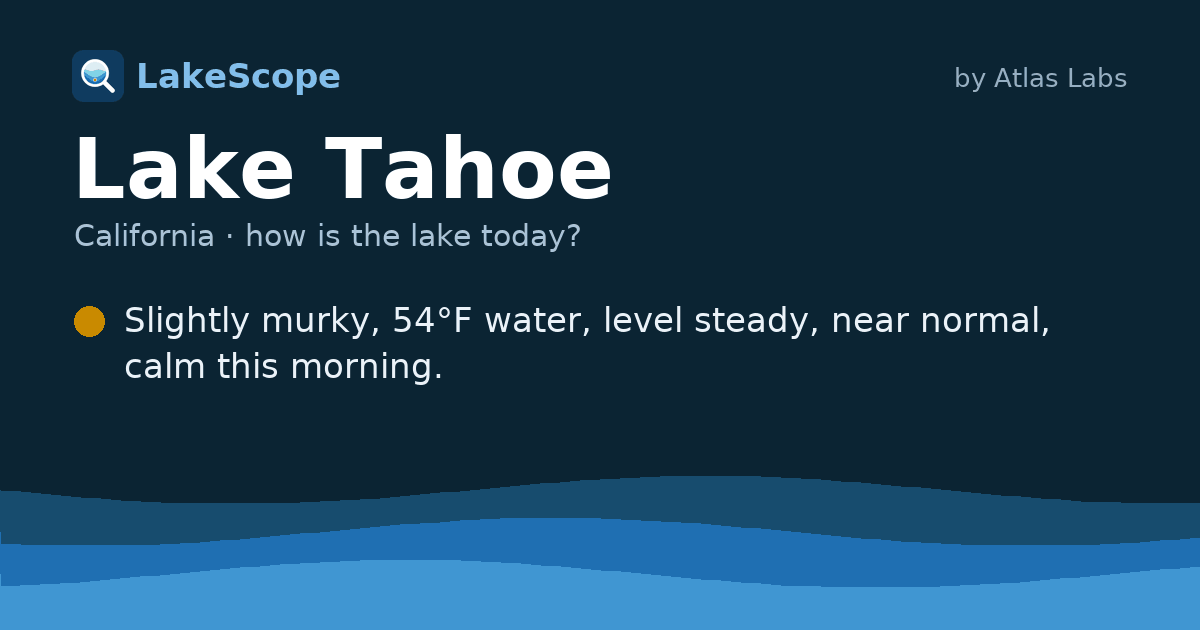
Tahoe's water level moves within a narrow natural range and a managed outlet, so changes are gradual rather than dramatic. What shifts more noticeably through the season is clarity and surface temperature: a warmer surface in midsummer pushes mackinaw and kokanee deeper, while a cooler, mixed-up fall column can bring them back up toward structure you can reach without going to the deepest basins.
Clarity itself can vary somewhat by season and by location around the lake, with some bays running slightly less clear than the open main body. That difference is rarely dramatic, but it's one more reason conditions in one part of Tahoe don't always match another.
Cold water is the real hazard here
- Tahoe's deep water stays cold even when the surface feels comfortable in summer, and sudden immersion in cold water can cause gasping and muscle failure within minutes.
- Wear a life jacket whenever you're on the water, not just when conditions look rough.
- Afternoon wind can turn a calm morning crossing into a dangerous one; plan return trips before wind typically builds.
- Boats capsize faster than people expect in cold, deep water, and swimming to shore from the middle of the lake is often farther than it looks.
- Check California's and Nevada's fishing license and limit rules for the lake before you go, since regulations can apply differently on each side.
- Tell someone your planned route and return time before heading out onto open water, especially if you're fishing alone or heading toward the less-trafficked parts of the lake.
Dressing and preparing for a cold-water lake
Because the risk at Tahoe is fundamentally about cold water rather than rough weather alone, dressing for the water temperature rather than the air temperature is the safer habit. A warm, sunny day on the surface doesn't change what happens if you end up in water that's only a few degrees above freezing at depth. Many experienced Tahoe anglers treat the lake with the same respect they'd give an ocean crossing, carrying extra layers, checking the forecast twice, and keeping a cushion of daylight in their plans rather than running the schedule tight.
Check before you go
Depth, clarity and wind make the difference between a good day on Tahoe and a dangerous one. LakeScope shows today's water temperature, level, wind and bite times for Lake Tahoe so you can plan around conditions rather than guess at them.
Questions
How deep is Lake Tahoe?
Around 1,645 feet at its deepest, making it one of the deepest lakes in the country.
What's the best fish to target at Lake Tahoe?
Mackinaw (lake trout) is the signature catch, usually taken by deep trolling. Kokanee and trout are also popular, and smallmouth bass hold around rocky structure in shallower coves.
Why is Lake Tahoe water so clear?
Very little algae or sediment suspends in the water, letting sunlight penetrate far deeper than in most lakes, which is also why fish here often hold much deeper than you'd expect.
Is Lake Tahoe cold even in summer?
Yes. The surface can warm up, but the deep water stays cold year-round, which is why cold-water safety matters even on a hot day.
Do I need a boat to fish Lake Tahoe well?
Shore fishing can work near points and coves, but most mackinaw and kokanee fishing happens by trolling deep water, which generally requires a boat.
Does Lake Tahoe's water level change much?
No, it moves within a fairly narrow managed range, so level changes are gradual compared to many reservoirs.
Lake Tahoe every morning
Water temperature, level, wind and bite times on your phone.